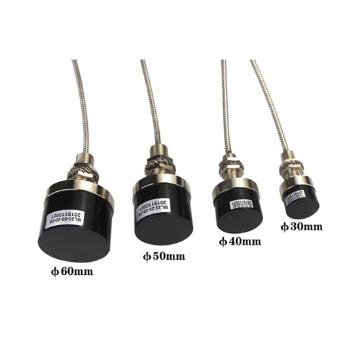
Eddy Current Type Displacement Sensor for Metal Position

SKU: SUCH-DPLS-ML33YD
$598.69
● Measurement ranges 10mm/20mm/25mm/40mm/50mm ● Frequency response: 100 Hz ● Power supply voltage: +12 VDC ● Output signal 4–20mA/1–5V/1–10V/RS485
*
*
🚚 Free shipping
🕒 Delivery date: 6-12 days
🔁 30-day Returns
Overview

Eddy current type displacement sensors are high-precision, non-contact metal position measurement sensors based on the eddy current effect. Employing an inductive measurement principle, they enable stable and reliable detection of the displacement of metal targets. SUCH eddy current displacement sensors offer multiple measurement ranges of 10 mm, 20 mm, 25 mm, 40 mm, and 50 mm, with a frequency response up to 100 Hz. They support +12 VDC power supply and offer a variety of output signal formats, including 4–20 mA, 1–5 V, 1–10 V, and RS485. The operating temperature range is -20℃~+60℃, making them suitable for high-precision, non-contact displacement measurement applications.

Note: Eddy current displacement sensors are custom-made products. Production requires specifying the material of the measured object. Therefore, the production cycle is 7~10 days. If you mind this, please consider carefully before ordering or contact customer service. Thank you!

Feature

  • Non-contact measurement with no mechanical wear, ensuring long service life.
  • High measurement accuracy with long-term reliable operation.
  • High sensitivity and fast response speed.
  • Strong anti-interference capability with stable signal output.

Eddy current type displacement sensor feature

Dimension (Unit: mm)

Eddy current type displacement sensor 10mm dimension

Eddy current type displacement sensor 20mm dimension

Eddy current type displacement sensor 25mm dimension

Eddy current type displacement sensor 40mm dimension

Eddy current type displacement sensor 50mm dimension

Specs
Measurement Range 10mm 20mm 25mm 40mm 50mm
Probe Diameter Φ30mm Φ40mm Φ50mm Φ60mm Φ70mm
Linearity Error (%FS) ≤±1 ≤±1 ≤±1 ≤±2 ≤±2
Repeatability 1-2um
Resolution (μm) 1~2 2~4 4~8 6~12 6~12
Frequency Response 100Hz
Output Signal 4~20mA, 1~5V, 1~10V, RS485
Supply Voltage +12VDC
Operating Current <20mA-60mA
Ripple ≤20mV
Linear Midpoint Temperature Drift Coefficient ≤0.1%/℃ (-20℃~60℃)
Static Sensitivity Depending on output signal and corresponding range
Output Load Voltage output: Load capacity <10KΩ
Current output: Load capacity <500Ω
Ambient Temperature During Calibration (20±5) ℃
Operating Temperature -20℃~+60℃
Protection Class Default IP67 (IP68 customizable)
Power Cable Default 2m twisted pair cable (length customizable)
Application
Automation equipment

Automation Equipment

Automotive industry

Automotive Industry

Precision manufacturing

Precision Manufacturing

FAQ

An eddy current displacement sensor operates based on the eddy current effect and belongs to a non-contact inductive measurement principle. An alternating current is applied to the coil inside the sensor probe, generating an alternating magnetic field around the probe. When a conductive material enters this magnetic field, eddy currents are induced in the target according to Faraday’s law of electromagnetic induction. In accordance with Lenz’s law, the magnetic field generated by the eddy currents opposes the original magnetic field of the coil, resulting in a change in the coil’s impedance. This impedance variation is directly related to the distance between the probe and the target. The controller detects the corresponding voltage change and calculates the displacement or position value.

When installing an eddy current displacement sensor probe, both the sensor’s linear measurement range and the total variation of the measured gap must be considered. It is recommended that the selected sensor’s linear range be at least 15% greater than the maximum expected gap variation to ensure stable and accurate measurement. For vibration measurement applications, the probe gap is typically set at the midpoint of the linear range. For displacement measurement applications, the probe gap should be determined based on the direction of displacement: if the displacement mainly moves away from the probe, the gap should be set near the lower end of the linear range; if the displacement mainly moves toward the probe, the gap should be set near the upper end of the linear range.

The measurement characteristics of an eddy current displacement sensor are closely related to the electrical conductivity and magnetic permeability of the target material. For ferromagnetic materials such as carbon steel or structural steel, both eddy current effects and magnetic effects are present, and the magnetic effect counteracts the eddy current effect, resulting in reduced sensor sensitivity. In contrast, for weakly magnetic or non-magnetic conductive materials such as copper, aluminum, and alloy steels, the magnetic effect is relatively weak and the eddy current effect is stronger, leading to higher sensor sensitivity. Therefore, material properties should be carefully considered during sensor selection and calibration, especially in high-precision measurement applications.

0.0 0
Write your own review Close
*
*