
Thermocouple


E Type Thermocouple, Stainless Steel, 0~400℃


J Type Thermocouple, 0~600℃


T Type Surface Thermocouple, -200~200℃


K Type Thermocouple Probe, 0~400℃


Pipe Thermocouple with Display, -50~100℃


K Type Thermocouple, Stainless Steel, 0~800℃


S Type Thermocouple, Corundum, 0~1600℃


B Type Thermocouple, Corundum, 0~1800℃


R Type Thermocouple, Sheathed, 0~1600℃


Handheld High Temperature Thermocouple, 0~1100℃
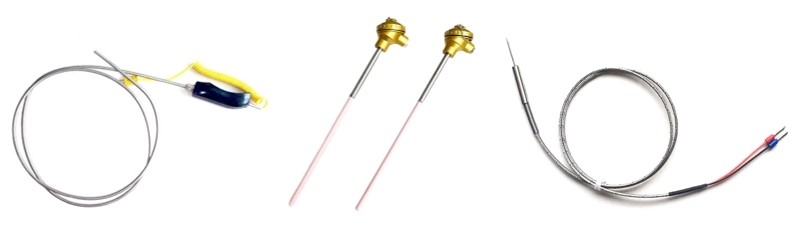
A thermocouple is a commonly used temperature sensor known for its simple construction, fast response time, and wide operating temperature range. It is widely applied in industrial, laboratory, and commercial environments where accurate and reliable temperature measurement is required.
Working Principle
Thermocouples operate based on the Seebeck effect. When two dissimilar metals are joined to form a circuit and the two junctions are at different temperatures, a small electrical voltage is produced. This voltage is proportional to the temperature difference and can be converted into a temperature reading using standardized calibration tables.
Common Types
Thermocouples are categorized by the metal combinations used in their construction. Common types include Type K, which is widely used for general applications, Type J for moderate temperature ranges, and Type T for low-temperature measurements. Specialized types such as Type E, N, S, R, and B are designed for high-temperature or precision applications.
Key Features
One of the main advantages of thermocouples is their ability to measure temperatures across a very wide range, from cryogenic levels to extremely high temperatures. They are highly durable, resistant to harsh conditions, and do not require an external power supply, making them suitable for continuous monitoring.
Applications
Thermocouples are used across a wide range of industries, including manufacturing, chemical processing, energy systems, laboratories, HVAC equipment, and safety monitoring devices. Their flexibility and reliability make them a standard choice for temperature sensing in many systems.


