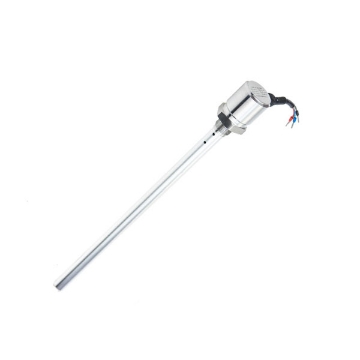
Stainless Steel Capacitance Type Level Transmitter for Hydraulic Oil

SKU: SUCH-CLS-GLTV7S
$166.91
● Measuring range up to 100-1400mm selectable ● Stainless steel and corrosion resistance for hydraulic oil ● Power supply 5V DC or 9-36V DC ● Output signals 4-20mA and RS485
*
*
🚚 Free shipping
🕒 Delivery date: 6-12 days
🔁 30-day Returns
Overview

SUCH stainless steel capacitance type level transmitter is designed for non-conductive hydraulic oil, offering a selectable measuring range of 100–1400 mm with ±1% accuracy and 0.01 mm resolution. Made of stainless steel, it operates reliably under pressures from -0.1 to 0.4 MPa and temperatures between -35 and 70 ℃, ensuring long-term durability. The capacitive liquid level sensor supports 5V or 9-36V DC power supply, provides 4-20 mA and RS485 outputs, and can integrate with GPS for real-time oil level monitoring.

Feature

  • Wide media compatibility: SUCH stainless steel capacitance type Level transmitter is suitable for non-conductive liquids such as hydraulic oil, gasoline, diesel, and kerosene, and also compatible with water, beer, and chemical reagents, covering a wide range of liquid level applications.
  • High accuracy and stability: This capacitive liquid level sensor provides ±1% accuracy and 0.01mm resolution with a built-in self-calibration function to ensure stable and reliable measurements without external calibration tools.
  • Rugged stainless steel construction: Stainless steel housing offers excellent corrosion resistance, withstanding pressures from -0.1 to 0.4MPa and operating temperatures from -35 to 70℃ for long-term use.
  • Flexible installation and signal output: It supports 5-hole flange or M20×1.5 threaded installation, with multiple output options including 4-20 mA, 0-5V, RS485, and RS232, and optional GPS integration for real-time level measurement.

Dimension (Unit: mm)

Capacitance type level transmitter dimension

Wiring Method

Output Mode Number of Wires Wiring Method
4~20mA 2 wires Red: 24V+
Black: 24V-
0~5V 3 wires Red: 24V+
Black: 24V-
Blue: 0~5V Voltage Output
RS485 4 wires Red: 24V+
Black: 24V-
Yellow: RS485 A
Blue: RS485 B
RS232 4 wires Red: 24V+
Black: 24V- (RS232 GND)
Blue: RS232 (RXD) Computer Transmit
Yellow: RS232 (TXD) Computer Receive
Specs
Measuring Range 100~1400mm Optional
Power Supply 5V, 9~36VDC
Accuracy ±1%, 0.5%
Resolution 0.01mm
Output Mode 4~20mA, 0~5V, RS485, RS232
Ambient Temperature -35~70℃
Rod Diameter Φ16
Weight 2kg
Pressure Range -0.1MPa~0.4MPa
Operating Current <10mA
Material Stainless Steel
Protection Class IP67
Explosion-Proof Grade Exd II CT5
Mounting Method Standard Flange/Threaded Mount M20×1.5 Optional
Application
Capacitive type level sensor for car fuel tank

Car Fuel Tank

Capacitive type level sensor for oil depot

Oil Depot

Capacitive type level sensor for oil tanker

Oil Tanker

FAQ

Stainless steel capacitive level transmitters are suitable for a variety of liquids and some solid particulate media, including water, oils, chemical solutions, corrosive liquids, slurries, powders, and granular materials. They are particularly ideal for media with stable dielectric constants. For media with significant foaming, strong adhesion, or large variations in dielectric constant, specific adjustments are needed during selection and parameter setting.

Yes, capacitive level transmitters usually require calibration during initial installation or when the medium changes. Common calibration methods include empty tank calibration and full-scale calibration. By setting the zero point and span under no-medium and full-scale liquid level conditions, the output signal is ensured to accurately correspond to the actual liquid level. Some models support on-site button calibration or remote parameter setting, which is relatively simple to operate.

Media adhesion or scaling on the probe surface can indeed affect capacitive measurement, especially after long-term operation. To reduce such effects, a probe with an anti-adhesion coating can be selected, or measurement accuracy can be maintained through parameter compensation and regular cleaning. In highly adhesive conditions, it is recommended to conduct an on-site assessment in advance and select a suitable probe structure.

0.0 0
Write your own review Close
*
*