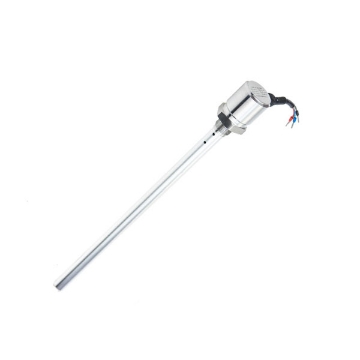
RF Capacitance Level Sensor for Corrosive Liquid, 4-20mA/RS485

SKU: SUCH-CLS-SP60
$417.50
● 0.5% F.S. accuracy for 0–300m liquid level measurement ● Probe temperature range -50°C to 250°C ● ExibIICT6 explosion-proof protection, IP67 protection rating ● Output options 4-20mA or RS485 ● Suitable for corrosive media such as sulfuric acid
*
*
🚚 Free shipping
🕒 Delivery date: 6-12 days
🔁 30-day Returns
Overview

SUCH RF capacitance liquid level sensor delivers 0.5% accuracy and reliable operation across extreme temperatures, pressures, and corrosive liquids. Its 316 stainless steel or PTFE construction, explosion-proof certification, and IP67 protection ensure long-term durability in harsh industrial conditions. With stable performance and standard 4-20mA or RS485 outputs, the capacitive type level transmitter integrates easily into monitoring systems for continuous level measurement.

Feature

  • High measurement accuracy: The RF capacitive level transmitter provides precise level monitoring with ±0.5% F.S. accuracy throughout the full 0–30 m range.
  • Exceptional temperature tolerance: Its probe is engineered to operate reliably in extreme process temperatures from -50°C up to 250°C.
  • Strong pressure capability: Designed to withstand medium pressures up to 4.0 MPa, making it suitable for pressurized tanks and vessels.
  • Durable materials: Constructed from 316 stainless steel or PTFE to ensure excellent resistance to corrosion and harsh chemical environments.
  • Certified for safety: This RF capacitance type level sensor is equipped with ExibIIBT6 explosion-proof certification and IP67 protection to ensure safe use in hazardous industrial areas.
  • Stable performance: Offers outstanding thermal stability with temperature drift ≤0.01% F.S./°C for consistent and reliable readings.
  • Versatile signal outputs: Comes standard with a 4–20mA output and supports optional HART or RS485 communication for seamless integration.
  • Wide media adaptability: Suitable for measuring purified water, alcohols, oils, acids, alkalis, and other common industrial liquids.
  • Reliable in harsh environments: Engineered to operate dependably in ambient temperatures ranging from -40°C to 85°C.

Dimension (Unit: mm)

RF capacitive level sensor dimension

Wiring Diagram

RF capacitive level sensor two wire current output

RF capacitive level sensor RS485 output

Installation Diagram

RF capacitive level sensor installation diagram

Specs
Measuring Range 100PF~5000PF
Detection Range 0-30m
Measurement Accuracy 0.5%F.S
Pressure Rating 16 kg (Higher ratings customizable)
Probe Temperature -50°C~250°C
Ambient Temperature -40°C~85°C
Storage Temperature -55°C~125°C
Supply Voltage 24V
Material 316 Stainless Steel, 1Gr18Ni19Ti, or PTFE
Explosion-proof Rating Exibllct6
Temperature Drift ≤0.01%FS/°C (within 0~70°C range)
Protection Rating IP67
Output Signal Standard 4-20mA (RS-485 communication optional)
Medium Temperature -30°C~350 °C
Medium Pressure 1.6, 2.5, 4.0 MPa
Suitable Applications Purified water, alcohol, alkali, nitric acid, oil, sulfuric acid
Application
RF capacitance level sensor for beverage production

Beverage Production

RF capacitance level sensor for geothermal power generation

Geothermal Power Generation

RF capacitance level sensor for offshore platform

Offshore Platform

FAQ

Yes. Conductive liquids will not harm capacitive measurements. Even with high liquid conductivity, the sensor probe usually has an insulating layer to prevent direct electrode contact. As long as the change in dielectric constant is significant enough, accurate measurement is possible. For high-salt, high-acid, or high-alkaline media, PTFE or PVDF materials are recommended to avoid corrosion.

Both metallic and non-metallic containers are acceptable, but metallic containers generally provide more stable measurements because they form a "natural second electrode." If the container is made of non-metallic materials such as plastic or glass, the sensor itself needs to form a complete capacitive circuit, thus requiring calibration or the use of a dual-electrode probe structure. As long as the installation method is correct, the container material will not affect the measurement reliability.

Possibly, but the impact is minor. If the medium is prone to scaling or wall adhesion, the buildup can alter the capacitance value, causing zero-point drift. Anti-scaling probes, PTFE sheaths, or installation locations away from areas prone to scaling can be used. If scaling is severe, regular cleaning and recalibration are necessary to maintain measurement accuracy.

0.0 0
Write your own review Close
*
*