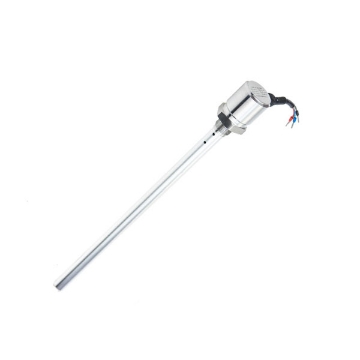
Frequency Difference Capacitive Liquid Level Switch

SKU: SUCH-CLS-300PC
$207.65
● Frequency-difference technology and precise liquid level measurement ● G1/2 inch process connection, IP67 protection rating ● 316L stainless steel construction ● Suitable for harsh industrial environments
🚚 Free shipping
🕒 Delivery date: 6-12 days
🔁 30-day Returns
Overview

Capacitive water level switch delivers accurate and consistent liquid level monitoring using advanced frequency-difference technology. Its 316L stainless steel build, PEEK components, and IP67 protection allow it to operate reliably in tough industrial settings. With a compact G1/2" connection and durable design, this liquid level sensor fits seamlessly into automated control systems for long-term level detection.

Feature

  • High Measurement Precision and Stability: The capacitive level switch delivers accurate, drift-free liquid level detection without mechanical components, ensuring dependable long-term performance in demanding operating environments.
  • Industrial-Grade Construction: Engineered with PEEK insulation, 316L wetted metal parts, and a 304 stainless steel housing, it offers exceptional corrosion resistance and robust durability for harsh industrial applications.
  • Advanced Intelligent Calibration: Integrated auto-calibration technology optimizes internal parameters in real time, minimizing manual configuration and enhancing commissioning efficiency.
  • Rapid Response: A fast reaction time (≤100 ms) combined with strong vibration tolerance (10G, 0–500 Hz) enables reliable performance in rapidly changing liquid level conditions.
  • Electrical Protections: Built-in reverse polarity, overload, and short-circuit safeguards ensure stable and secure operation within complex control systems.
  • Flexible Installation and System Integration: The capacitive liquid level sensor supports a G1/2" process interface, M12*1 electrical connector, and an 18-30 VDC supply range, enabling simple setup and broad compatibility with industrial equipment.
  • IP67 Environmental Protection: It maintains reliable operation against water immersion and dust ingress, making it suitable for rugged field environments.
  • Continuous Status Feedback: Designed for real-time liquid level measurement, the water level switch provides immediate output signals to enhance process visibility and control accuracy.

Dimension (Unit: mm)

Capacitive liquid level switch dimension

Connection

Capacitive liquid level switch connection

Specs
Process Connection G1/2" Male Thread
Wetted Material PEEK, 316L Stainless Steel
Housing Material 304 Stainless Steel
Weight 300g
Connection Type M12*1 Connector
Supply Voltage 18 VDC to 30 VDC
Wiring Protection Reverse Polarity, Overload, and Short-circuit Protection
Protection Grade IP67
Current Consumption ≤35 MA
Response Time ≤100 MS
Vibration Resistance 10G / 0~500Hz
Shock Resistance 50G / 1 MS
Vibration Frequency 300 ± 50Hz
Process Pressure -1 to 40 BAR


Application
Capacitance type level switch for petroleum industry

Petroleum Industry

Capacitance type level switch for chemical industry

Chemical Industry

Capacitance type level switch for metallurgical industry

Metallurgical Industry

FAQ

Yes, this is one of the advantages of capacitive sensors. They can detect plastic granules, grain powder, feed, flour, cement powder, etc. Powder silos typically use side-mounted switch-type or top-mounted continuous capacitive probes. Note that dust accumulation can cause long-term capacitance shift; therefore, anti-adhesion probes should be selected or cleaned regularly.

The delay is very small, typically only a few hundred milliseconds. It is a fast-response sensor suitable for dynamic level monitoring, such as pump control and valve regulation. A buffering effect may occur when there is a large drop in powder volume in a soft silo; this is not a sensor delay but rather caused by the flow characteristics of the medium.

Temperature variations will cause a shift in the dielectric constant, but modern sensors typically have temperature compensation functions, so they will not cause significant errors. If the ambient temperature difference exceeds 50°C, it is recommended to choose a wide-temperature-range probe. If high temperatures cause the probe rod to expand, high-temperature resistant materials must be used.

0.0 0
Write your own review Close
*
*