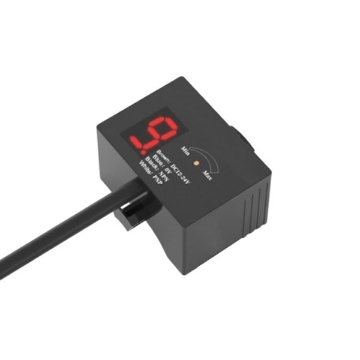
Capacitance Probe Level Sensor for Liquid/Powder

SKU: SUCH-CLS-12NPFL
$95.29
● Power supply 12-24V DC ● Signal output NPN+PNP ● Operating temperature range -25℃ to 70℃ ● Suitable for high and low viscosity liquids with low corrosivity, such as glue, lubricating oil, and ink
🚚 Free shipping
🕒 Delivery date: 6-12 days
🔁 30-day Returns
Overview

This contact capacitance level sensor uses a 316L stainless steel housing and a PEEK probe, making it suitable for monitoring high and low viscosity liquids such as glue, lubricating oil, and ink. It supports a 12-24 VDC power supply, features a fast 20ms response time, and operates at a 50Hz switching frequency for real-time level detection. With IP65 protection, an operating temperature range of -25℃ to 70℃, adjustable sensitivity, and built-in electrical protections, it offers reliable and safe performance in industrial applications.

Feature

  • Wide media compatibility: Based on contact capacitance sensing technology, the sensor reliably detects both high- and low-viscosity, low-corrosive liquids such as glue, lubricating oil, and ink. It adapts to diverse industrial liquid monitoring applications without the need for frequent sensor replacement.
  • Robust and durable design: SUCH capacitive liquid level sensor features a 316L stainless steel housing combined with a PEEK probe, supporting a pressure range of 0-0.4 MPa and an IP65 protection rating. Stable operation is ensured across a temperature range of -25 ℃ to 70 ℃, even in harsh environments with moisture and dust.
  • Fast and accurate level detection: With a 20 ms response time and 50Hz switching frequency, the capacitive type level transmitter captures liquid level changes in real time. Sensitivity can be precisely adjusted via a multi-turn potentiometer to match different liquid properties and improve detection accuracy.
  • Low maintenance and high reliability:  The capacitive level sensor operates on a 12-24 VDC wide-voltage power supply and integrates reverse polarity and overcurrent protection to minimize failure risks. A 4-core 2-meter PVC cable allows easy installation, while dual-color indicator LEDs provide clear and intuitive status indication.

Dimension (Unit: mm)

Capacitance probe level sensor dimension

Installation Diagram

Side install

Capacitance probe level sensor side installation diagram

Top/Bottom install

Capacitance probe level sensor top/bottom installation diagram

High/Low liquid level install

Capacitance probe level sensor high/low liquid level installation-diagram

Note: The sleeve needs to be configured by the customer.

Wiring Diagram

Capacitance probe level sensor wiring diagram

Specs
Detection Principle Contact Capacitance Detection
Output Mode NPN+PNP
Application Glue, lubricating oil, ink (high viscosity, low corrosion materials)
Detection Distance Contact Detection
Withstand Voltage 0-0.4Mpa
Power Supply Voltage 12-24VDC
Sensitivity Multi-turn Potentiometer Adjustment
Response Time 20ms
Switching Frequency 50HZ
Indicator Light Red: Power Indicator; Green: Output Indicator
Working Power <0.5W
Maximum Output Current 100mA
Residual Voltage <1.5VDC (at 100mA load current, 2m wire)
Internal Protection Reverse Polarity Protection, Overcurrent Protection
Housing Material PEEK+316L Stainless Steel
Ambient Temperature -25℃~70℃
Protection Grade IP65
Dimension M12*75mm
Weight 200g
Connection Method 4-core 2m PVC Lead Wire
Application
Capacitive probe level-sensor for engine oil

Engine Oil

Capacitance probe level-sensor for glue

Glue

Capacitance probe level-sensor for powder

Powder

FAQ

Yes, capacitive level sensors can measure both conductive and non-conductive liquids. Unlike electrode-type level switches, capacitive sensors do not rely on the conductivity of the medium, but rather determine the liquid level through changes in dielectric constant. Therefore, they can maintain good detection performance when measuring non-conductive or weakly conductive media such as oils, pure water, and alcohol.

In metal containers, the container wall usually acts as a reference electrode, resulting in more stable measurements; while in non-metal containers such as plastic and glass, an external reference electrode or a specially designed capacitive probe is required. When selecting a sensor, the container material should be clearly specified to ensure that the sensor's working principle functions correctly.

Capacitive probe level sensors are more commonly used for point level detection, such as high-level, low-level alarms, or overflow protection. Although some models can achieve approximate continuous measurement, for high-precision continuous liquid level measurement applications, ultrasonic, radar, or hydrostatic level gauges are usually recommended.

0.0 0
Write your own review Close
*
*