All Categories
    Menu Close
    Find a Sensor A - Z

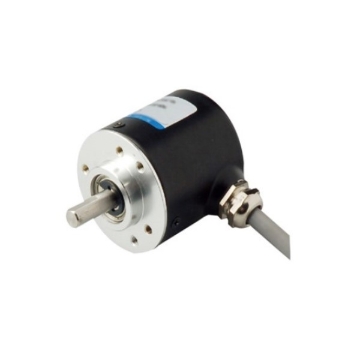
    Small Incremental Rotary Encoder with Solid Shaft, 500 ppr

    SKU: SUCH-IRE-500PS
    $142.22
    ● Resolution 500 ppr ● Cable edge output ● Maximum shaft radial load 50N ● Maximum shaft axial load 20N
    *
    *
    *
    🚚 Free shipping
    🕒 Delivery date: 6-12 days
    🔁 30-day Returns
    Overview

    Small incremental rotary encoder with a solid shaft available for sale online. The 500 ppr incremental rotary encoder is available in 5VDC/8-30VDC voltage options, with a shock resistance of 50G/11ms and a maximum shaft speed of 5000 r/min. The SUCH small incremental rotary encoder can operate stably in a temperature range of -30℃ to 85℃ and can be used in industrial automation control and measurement fields.

    Feature

    • Dedicated ASIC chip ensures stable signal, safety, and reliability, guaranteeing output pulse accuracy.
    • The encoder boasts a robust and durable structure, long service life, high stability, and strong protection capabilities.
    • The incremental encoder is compact and lightweight, easy to install, and can operate stably in complex environments.

    Dimension (Unit:mm)

    Small rotary encoder dimension

    Wiring

    Color Signal
    Red Vcc
    Black GND
    Green A
    White B
    Yellow Z
    Brown A-
    Gray B-
    Orange Z-
    Specs
    Maximum Shaft Speed 5000 r/min
    Starting Torque <0.03Nm (25℃)
    Maximum Shaft Load Radial load: 50N, axial load: 20N
    Shock Resistance 50G/11ms
    Anti-vibration 10G (10~2000Hz)
    Rotational Inertia 4*10-8kgm2
    Operating Temperature -30~+85℃ (-22~+185℉)
    Storage Temperature -35~+95℃ (-31~+203℉)
    Protection Level IP51
    Weight 100g


    Electrical Parameters

    Output Circuit Open-collector Voltage
    Supply Voltage Vcc DC 5V±0.2 DC 5~24V DC 5V±0.2/DC 5~24V
    Current Consumption ≤60mA ≤60mA
    Output High Level ≥3.5V ≥Vcc-2.5V -
    Output Low Level ≤0.5V ≤0.5V -
    Rise Time Tr ≤500ns ≤1500ns -
    Fall Time Tf ≤100ns ≤300ns -
    Maximum Frequency Response 0 ~ 100kHz


    Output Circuit Push-pull Line Driver
    Supply Voltage Vcc DC 5V±0.2/DC 5~24V DC 5V±0.2 DC 5~24V
    Current Consumption ≤60mA ≤100mA
    Output High Level - ≥2.5V ≥Vcc-2.5V
    Output Low Level - ≤0.5V ≤1.0V
    Rise Time Tr - ≤200ns ≤500ns
    Fall Time Tf - ≤200ns ≤200ns
    Maximum Frequency Response 0 ~ 100kHz


    Model Selection

    Shaft Type S: Shaft
    Diameter of Shell 38: 38mm
    Diameter of Shaft 06: 6mm
    Connection Type G: Cable edge output
    Cable Length* 1: 1m
    2: 2m
    3: 3m
    4: 4m
    Resolution 500: 500 ppr
    Production Identifier B
    Z Signal M: Output 1 if receiving Z signal
    Z Signal Wavelength Default: 1T
    Output Mode * C: Open-collector NPN
    CP: Open-collector PNP
    T: Voltage output NPN+R
    P: Push-pull output NPN+PNP
    L: Line driver 26LS31
    K: Line driver 7272
    Voltage * 5: +5VDC
    830: +8~30VDC

    Note: * indicates optional parameters. You can select parameters from the drop-down list. Some custom parameters cannot be selected directly from the list. Please contact us for assistance.

    Application
    Incremental encoder for displacement measurement


    Displacement Measurement

    Incremental encoder for position measurement


    Position Measurement

    Incremental encoder for speed control


    Speed Control

    FAQ
    • Solid shaft: The encoder has a fixed, solid shaft that must be coupled to the motor or system shaft with a coupling. It is simple, robust, and common in smaller or standard applications.
    • Hollow shaft: The encoder has a hollow center that allows it to be mounted directly over a shaft, reducing coupling parts and simplifying installation. Hollow shafts are ideal for compact or high-precision applications.

    "Incremental" means the encoder generates pulses relative to shaft movement. It measures speed, direction, and relative position but does not retain absolute position after power loss; a reference or zeroing procedure is needed.

    Yes. Incremental encoders have two output channels (A and B) in quadrature. By comparing the phase difference between these channels, the system can detect the rotation direction of the shaft.

    0.0 0
    Write your own review Close
    *
    *