
Incremental Encoder


Optical Incremental Rotary Encoder, 360/800/1500/3600 ppr


Miniature Incremental Rotary Encoder, 1000 ppr


Hollow Shaft Optical Incremental Encoder, 200~5400 ppr


Incremental Optical Encoder Sensor with Solid Shaft, 100 ppr


Miniature Optical Incremental Encoder, 400 ppr


Small Incremental Rotary Encoder with Solid Shaft, 500 ppr


Square Flange Optical Incremental Encoder, 600 ppr


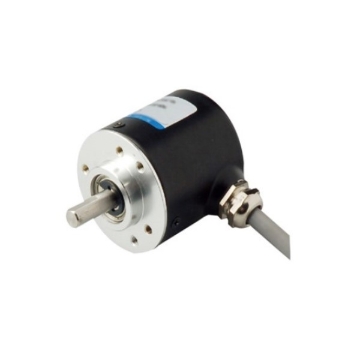
Optical Incremental Rotational Shaft Encoder, 1000 ppr


Incremental Optical Rotary Encoder with Square Flange, 1024 ppr


Incremental Rotational Encoder for Robot, 2000 ppr


Shaft Type Optical Incremental Rotary Encoder, 5000 ppr


Incremental Shaft Rotational Encoder, 1200~3000 ppr


Hollow Shaft Photoelectric Incremental Encoder, 1000~5000 ppr


Non-Contact Incremental Elevator Encoder, 100~1000 ppr


Photoelectric Incremental Encoder, 1000~5000 ppr
An incremental encoder is a sensor that reflects changes in rotational or linear displacement by outputting pulse signals. The working principle of an incremental encoder is to convert mechanical motion into periodic electrical signals, and calculate position, speed, and direction by counting the pulses. Incremental encoders typically output two-phase quadrature pulse signals (A and B phases) and may also include a zero-position signal (Z phase). The rotation direction can be determined by analyzing the phase difference between the A and B phases, while the Z phase signal is used to provide a reference zero point or homing position.
Unlike absolute encoders, incremental encoders offer advantages such as simple structure, lower cost, and faster response, making them ideal for applications requiring rapid feedback, such as motor speed measurement, conveyor belt speed control, and general positioning and closed-loop control systems. However, the limitation of incremental encoders is that they cannot retain position information after power failure, so a zero-return operation is usually required to re-establish the reference point during use.
Incremental encoders can be used for rotary shaft or linear motion detection and are widely used in servo systems, motor control, automated production lines, CNC machine tools, and robotics. In industrial applications, incremental encoders provide high-resolution and high-precision signal output. Furthermore, because the output pulse frequency is proportional to the speed, incremental encoders can also achieve speed measurement and rotational speed control. When used in conjunction with a controller or PLC, incremental encoders can achieve closed-loop feedback regulation, ensuring the stability and accuracy of equipment operation, making them one of the indispensable basic sensors in modern industrial automation.


