Signal Isolator


4-20mA Signal Isolator, Explosion Proof, DC 24V


Analog Signal Isolator, Loop/External Powered, 4-20mA


DC Signal Isolator, 4-20mA/0-10V, 1/2 Outputs


Signal Isolator, 4-20mA, HART Pass-through


Signal Isolator, Frequency/Pulse to 4-20mA/0-10V


Signal Isolator, High Accuracy Programmable, 4-20mA/0-10V


Signal Isolator, Multi-Input (TC/RTD), MODBUS-RTU Output


Signal Isolator, Potentiometer/Resistance Input, 4-20mA Out


Signal Isolator, Temperature Input, K/B/S/PT100


Signal Isolator, Temperature RTD Pt100 Input, 0-10V/4-20mA Output


Signal Isolator, Thermocouple/RTD Input, 4-20mA Output


Signal Isolator, Universal Analog Input, 4-20mA/0-10V
An industrial signal isolator receives DC (4-20mA) or voltage (0-10V) signals from field sensors (pressure, temperature, flow, level transmitters, potentiometers, frequency devices, thermocouples, RTDs) and provides a clean, isolated analog output to PLCs, DCS, displays, or SCADA systems. It breaks ground loops, rejects electrical noise, and protects sensitive analog input cards from surges and accidental high-voltage contacts.
Working Principle
Think of a signal isolator like a messenger that stands between a sensor and a control system. The sensor sends a small electric signal – like 4‑20 mA or 0‑10 V – but that signal can carry unwanted “noise” from motors, pumps, or ground loops. That noise can confuse the control system or even damage its input card.
About Certifications
You don’t have to be an expert to know that industrial equipment needs to be safe. SUCH isolators come with key certifications that matter for real-world jobs:
- ATEX / Intrinsic Safety (Ex ia) – This is the standard for explosive areas, like around gas or dust. It means the isolator limits electrical energy so much that it simply cannot create a spark—even if something goes wrong inside. If you work in oil, gas, or chemical plants, this keeps people and equipment alive.
- SIL (Safety Integrity Level) – For systems where a wrong reading could cause a disaster (like a tank overflowing or a pipe bursting), this certificate guarantees the isolator will do its job reliably, with a mathematically proven low failure rate.
- EMC (Electromagnetic Compatibility) – Factories are full of motors, drives, and radios that throw out electrical “noise.” This certificate proves the isolator won’t be confused by that noise and won’t mess up other devices nearby.
In short: these aren't just fancy stickers. They are your proof that the isolator will survive the factory floor and keep your control system safe.
Signal Isolator Selection Guide
|
Isolator Type |
Input Signals |
Output Signals |
Key Application |
|
4-20mA, 0-10V, 0-20mA |
4-20mA, 0-10V, 0-20mA (single/dual output) |
General-purpose isolation for pressure, level, and flow transmitters; breaks ground loops; protects PLC analog input cards |
|
|
Thermocouple (K/E/S/B/J/T/R/N/WRe), RTD (Pt100/Cu50/Cu100/BA1/BA2) |
4-20mA, 0-10V |
Converts temperature sensor inputs to standard analog signals with built-in cold junction compensation and graded accuracy |
|
|
RPM pulses, flow pulses, OC, square wave, sine wave (0-100kHz) |
4-20mA, 0-10V |
Converts frequency-output sensors (encoders, proximity switches, flow meters) to analog signals for PLC/DCS integration |
|
|
4-20mA from hazardous-area sensors |
4-20mA (active/passive), 0-10V |
[Ex ia Ga] II C certified for Zone 0 explosive atmospheres; 2500VAC isolation between safe and hazardous sides |
FAQ
Q1: My isolator smoked or smelled burnt. What do I do?
A: Turn off power immediately! Then check if you accidentally connected 220V to a 24V input – that's the #1 killer. Also verify your power supply voltage matches the model. Check for short circuits between terminals. If everything looks correct, contact SUCH for a replacement – these isolators have built‑in protection, but wrong voltage will still fry them.
Q2: What's the difference between 1‑in‑1‑out, 1‑in‑2‑out, and 2‑in‑2‑out?
A: 1‑in‑1‑out: one sensor to one PLC channel. 1‑in‑2‑out: one sensor signal goes to two different devices (e.g., PLC and display). 2‑in‑2‑out: two sensors go to two separate outputs – each channel is independent. Pick based on how many devices you need to send the signal to.
Q3: My isolator has no output. What should I check first?
A: Check the power light – if off, check the 24VDC supply and polarity. Then check input wires: 4‑20mA has + and –, swap them and you get nothing. If your model has DIP switches, make sure they match your sensor type (2‑wire vs powered). Still no output? Check the load resistance – too high kills the signal.
Q4: How do I connect a 2‑wire, 3‑wire, or 4‑wire transmitter?
A: 2‑wire: power and signal share the same two wires – just connect to the isolator's input terminals. 3‑wire: power+, signal+, and common ground – connect all three. 4‑wire: two wires for power (external supply) and two for signal – connect signal wires to isolator input, and power separately. Check the manual for terminal labels – they tell you exactly where each wire goes.
Main Application Areas
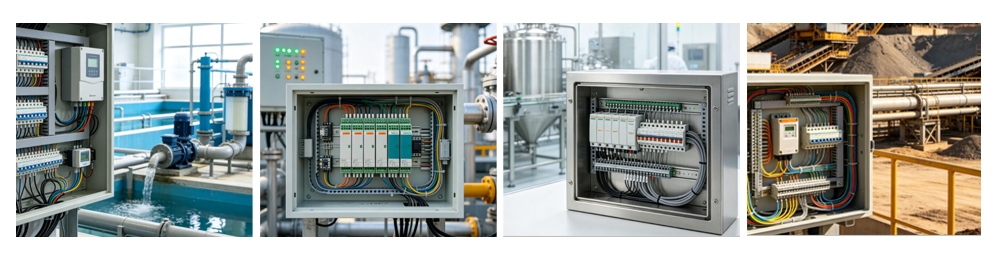
Permanently installed on 35mm DIN rails inside control panels, junction boxes, or explosion-proof enclosures, signal isolators are used in oil & gas, chemical processing, water/wastewater treatment, HVAC, power generation, food & beverage, pharmaceutical manufacturing, and mining operations. They trigger alarms, drive control valves, feed historian data, or enable safe communication between hazardous-area sensors and safe-area control systems. Terminal labels – they tell you exactly where each wire goes.