
Encoder


Square Flange Optical Incremental Encoder, 600 ppr

Magnetic Scale Linear Encoder for Flexible Wires, SSI/BISS-C/TAMA/RS485


Multi Turn Hollow Shaft Absolute Encoder, 16 Bit


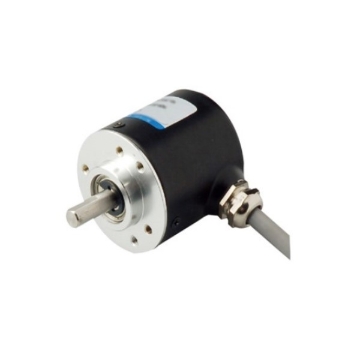
Optical Incremental Rotational Shaft Encoder, 1000 ppr


Incremental Optical Rotary Encoder with Square Flange, 1024 ppr


Magnetic Absolute Encoder, Shaft, 12 Bit

Non-Contact Magnetic Incremental Linear Encoder, RS422


Absolute Optical Rotary Encoder for Motor, 17~24 Bit

Contactless Magnetic Scale Linear Encoder, 5V/7~28V


Incremental Rotational Encoder for Robot, 2000 ppr


Absolute Magnetic Rotary Encoder, SSI Output

High Resolution Magnetic Incremental Linear Encoder, 1μm


Shaft Type Optical Incremental Rotary Encoder, 5000 ppr


Incremental Linear Scale Encoder for Press Brake, 5V/8~24V


Incremental Shaft Rotational Encoder, 1200~3000 ppr


Hollow Shaft Photoelectric Incremental Encoder, 1000~5000 ppr


Spring Type Incremental Linear Encoder Sensor, 8~24V


Non-Contact Incremental Elevator Encoder, 100~1000 ppr


Photoelectric Incremental Encoder, 1000~5000 ppr
An encoder is a sensor that converts physical quantities such as mechanical displacement, angle, or velocity into electrical signals or digital codes. The encoder is primarily used in motion control systems for the precise detection and feedback of position, velocity, and direction. The core working principle of an encoder is the interaction between its internal encoding medium and the sensing element, which converts continuous mechanical motion into discrete or continuous electrical signals. These signals are then processed by circuitry and output as information recognizable by the control system, thereby achieving precise monitoring of the motion state. SUCH offers a variety of high-quality encoders to suit different application scenarios.
Types of Encoders
Classification by Output Signal Type
 Absolute Encoder: Absolute encoders use a unique internal code disk to assign a unique position code to each rotational position, allowing direct reading of the current precise angle without cumulative counting. Even after a power outage and restart, the device can immediately identify its position without losing position information, truly achieving positioning upon power-on and eliminating the need for homing. Absolute encoders are suitable for automated equipment with high requirements for position reliability and safety.
 Incremental Encoder: Incremental encoders generate pulse signals using evenly distributed grating grids on a code disk. The motor outputs one pulse for every fixed angle it rotates. By counting the number and frequency of pulses, the distance and speed of rotation are determined, and the direction of rotation is determined by the phase difference. Incremental encoders have a simple structure and fast response speed, but they cannot remember the position after a power failure. After power is restored, a zero-return operation is required to determine the reference position.
Classification by Measurement Object
 Rotary Encoder: A rotary encoder is a sensor used to detect rotational motion. The rotary encoder is typically mounted on a motor shaft or other rotating mechanism and converts changes in the angle of mechanical rotation into an electrical signal output, thereby achieving precise measurement and feedback control of position, speed, and direction of rotation. Both incremental and absolute encoders can be made in rotary form, making them very common in servo systems, frequency converters, elevator controls, fans, and pumps.
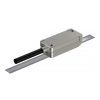 Linear Encoder: A linear encoder is a high-precision sensor used to measure linear displacement and position changes. The linear encoder typically consists of a scale (optical or magnetic) and a reading head. It directly converts the linear motion of an object into an electrical signal output, thereby achieving real-time detection and feedback control of position, speed, and displacement changes. Because it can directly measure linear motion without mechanical conversion, linear encoders have advantages such as high accuracy, fast response, and good repeatability.
Features of Encoders
- Encoders offer high measurement accuracy, ensuring smooth equipment operation and precise positioning, thereby enhancing the quality of product processing and operation.
- They can detect equipment speed, direction, displacement, and angle in real time, converting mechanical motion into electrical signals to enable the control system to accurately sense position.
- Compact encoders are space-saving, making them easy to install and compatible with a wide range of automated equipment, including motors, machine tools, and robots.
- They feature fast response times, stable signal output, and strong resistance to interference, enabling them to operate reliably over the long term in industrial environments.
- With their versatility and excellent compatibility, encoders can be used in conjunction with servo systems, PLCs, and controllers, serving as the core sensing components of automated equipment.
Applications of Encoders
- In CNC machine tools and machining equipment, encoders enable precise positioning of cutting tools and worktables, ensuring machining accuracy and product consistency.
- For robots and robotic arms, encoders provide real-time feedback on joint angles, enabling more flexible movements and more accurate positioning.
- When used in elevators and hoisting equipment, they precisely detect the position and speed of the car, ensuring smooth operation and safe stopping.
- In logistics conveying and packaging machinery, encoders work with systems to monitor conveyor belt speed and material position, improving automation efficiency.
- Used in textile, printing, and papermaking equipment to achieve speed synchronization and length measurement, preventing deviation and errors.
- Within servo motors and automated production lines, encoders serve as core feedback components, enabling high-speed, high-precision motion control.


