
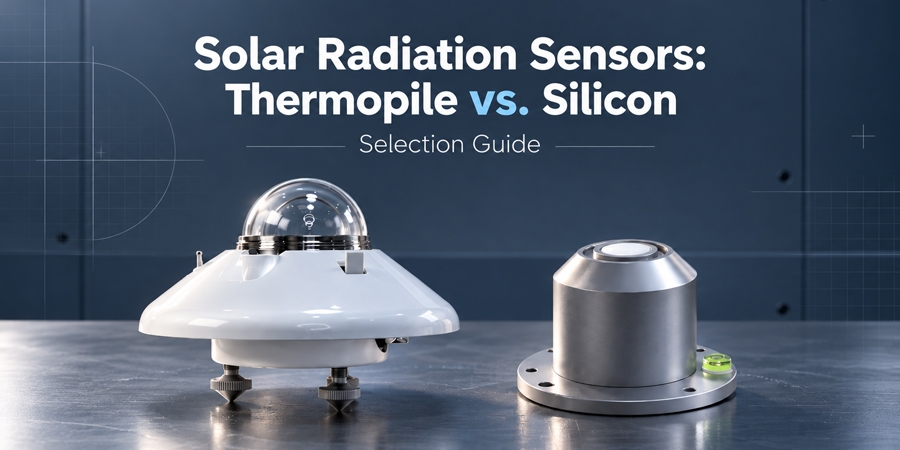
Pyranometer vs. silicon solar radiation sensor, which should you choose? Solar irradiance measurements are widely used in photovoltaic performance monitoring, meteorological stations, and environmental research. However, selecting a solar radiation sensor based only on its measurement range can introduce significant measurement uncertainty. Thermopile pyranometers and silicon photodiode radiation sensors both measure solar irradiance in W/m², but they respond differently to solar wavelengths, incident angles, and changing weather conditions.
The primary selection criterion is spectral response, followed by measurement uncertainty, response time, and installation requirements.
1. Spectral Response: 280–3000 nm vs. 400–1100 nm
A thermopile pyranometer measures solar radiation through a broadband thermal detector. Incoming radiation heats a black-coated sensing element, generating a thermoelectric voltage proportional to irradiance.
A silicon solar radiation sensor uses a photodiode to convert incident light into an electrical signal. Its spectral sensitivity is determined by silicon's semiconductor properties and the optical design.
Consider two SUCH radiation sensors:
| Specification | Thermopile Pyranometer | Silicon Solar Radiation Sensor |
|---|---|---|
| Sensor Technology | Thermopile | Silicon photodiode |
| Spectral Range | 280–3000 nm | 400–1100 nm |
| Measurement Range | 0–2000 W/m² | 0–2000 W/m² |
| Response Time | ≤13 s (99%) | 1 s (95%) |
| Nonlinearity | ±1% maximum | ±1% |
| Annual Stability Specification | ±2% | <2% |
| Output Options | 0–20 mV, 4–20 mA, RS485 | 0–20 mV, 4–20 mA, RS485 |
The thermopile pyranometer covers a considerably wider wavelength range, including more ultraviolet and infrared radiation.
A silicon detector responds mainly between 400 and 1100 nm. Because the solar spectrum changes with atmospheric conditions, the relationship between silicon sensor output and broadband irradiance is not constant.
Engineering implication: A silicon sensor calibrated under one spectral distribution may produce a different irradiance error under cloudy skies or changing atmospheric conditions. A spectrally flat thermopile pyranometer generally reduces this source of uncertainty.
2. Measurement Accuracy: Why Spectral and Directional Errors Matter
A sensor's measurement range does not determine its accuracy.
For example, the SUCH thermopile pyranometer specifies:
-
Spectral error: ±3%
-
Nonlinearity: less than ±1%
-
Directional response error: ±18 W/m²
-
Thermal radiation zero drift: within ±10 W/m²
The SUCH silicon radiation sensor specifies:
-
Measurement accuracy: less than ±5%, typically ±3%
-
Nonlinearity: ±1%
-
Cosine response error: less than 10% up to 80° incidence
These parameters describe different error mechanisms and should not be interpreted as directly equivalent overall accuracy ratings.
How Can Directional Error Affect Measurements?
For a correctly leveled sensor, the contribution of direct solar radiation depends on the angle of incidence:
Irradiance on the sensor = Direct Normal Irradiance × cos(θ) + Diffuse Irradiance
Here, θ is the angle between the incoming direct sunlight and the sensor normal. This expression assumes diffuse irradiance is already measured on the same plane.
At a 60° incidence angle, the cosine factor is 0.5. A sensor with an imperfect cosine response may deviate from this relationship, introducing measurement error.
Directional response becomes especially important during early morning and late afternoon measurements when solar incidence angles are large.
For reference-quality irradiance monitoring, the sensor's documented directional response and spectral error should be evaluated together rather than relying on a single accuracy percentage.
3. Response Time: Which Sensor Tracks Rapid Irradiance Changes Better?
Rapidly changing cloud cover can produce substantial irradiance fluctuations over a few seconds.
The SUCH silicon sensor specifies a response time of 1 second to reach 95% of a step change. The thermopile pyranometer specifies 13 seconds or less to reach 99%.
The response-time percentages differ, so these values are not strictly equivalent. Nevertheless, the silicon sensor is designed for faster measurement response.
This distinction affects three common applications:
| Application | Technical Consideration |
|---|---|
| Rapid cloud-transient monitoring | Shorter response time helps capture fast irradiance changes |
| Long-term solar energy monitoring | Spectral response and measurement uncertainty are important |
| PV performance analysis | Sensor response time should match the monitoring system's sampling interval |
A faster sensor is not automatically more accurate. It may record rapid changes more effectively while retaining spectral measurement errors.
4. PV Monitoring: When Is Broadband Measurement Necessary?
Photovoltaic performance monitoring typically compares generated electrical power with incident solar irradiance.
A simplified performance ratio can be expressed as:
PR = Actual Energy Output / Reference Energy Output
The reference energy output depends on measured irradiance, installed PV capacity, and the reference irradiance.
Consequently, irradiance measurement errors affect the calculated performance ratio.
For example, suppose a monitoring system records an irradiance of 900 W/m² when the reference irradiance is 950 W/m².
The relative measurement error is:
Error = (900 − 950) / 950 × 100% = −5.26%
If the irradiance reading is underestimated, a performance ratio calculated using that reading will generally be overestimated, assuming other inputs remain unchanged.
A thermopile pyranometer is generally preferable for broadband solar resource assessment and applications requiring lower spectral uncertainty.
A silicon sensor can be suitable for routine PV monitoring, particularly when its calibration and spectral characteristics are appropriate for the photovoltaic technology being monitored.
For contractual performance testing, select instruments according to the applicable project requirements and measurement standards.
5. Installation and Data Acquisition Requirements
Both sensor types require appropriate mounting and calibration to produce reliable measurements.
Sensor orientation: For global horizontal irradiance (GHI), install the sensing surface horizontally. For plane-of-array irradiance (POA), align the sensor with the PV module plane.
Shading: Avoid obstructions that cast shadows across the sensing surface. Partial shading can introduce measurement errors that are unrelated to the sensor's electrical specifications.
Signal interface: SUCH offers both sensor types with millivolt, 4–20 mA, and RS485 output options. A millivolt output requires a compatible high-resolution measurement input. A 4–20 mA interface is practical for industrial analog acquisition, while RS485 supports digital integration with compatible monitoring systems.
Calibration and maintenance: Inspect optical surfaces, verify sensor leveling, and follow the manufacturer's calibration interval. Outdoor contamination can produce additional measurement errors even when electronic calibration remains unchanged.
6. Which Solar Radiation Sensor Should You Choose?
| Selection Requirement | Recommended Sensor | Primary Reason |
|---|---|---|
| Broadband solar irradiance monitoring | Thermopile pyranometer | Wider spectral response |
| Meteorological research | Thermopile pyranometer | Reduced spectral dependence |
| Routine PV system monitoring | Silicon or thermopile sensor | Depends on required measurement uncertainty |
| Rapid irradiance fluctuations | Silicon radiation sensor | Shorter specified response time |
| Long-term solar resource assessment | Calibrated thermopile pyranometer | Broadband measurement capability |
| Industrial environmental monitoring | Either type | Depends on accuracy and integration requirements |
For applications requiring broadband measurement over 280–3000 nm, the SUCH Pyranometer Solar Radiation Sensor provides thermopile-based irradiance measurement with multiple output interfaces.
For applications prioritizing faster irradiance response and compact installation, the SUCH Silicon Solar Radiation Sensor offers a 400–1100 nm spectral range, 1-second specified response time, and industrial output options.


