
Magnetic Sensor


Magnetic Cylinder Sensor 3 Wire, PNP / NPN


Magnetic Cylinder Sensor 2 Wire, IP64 / IP 68


Magnetic Reed Switch Sensor, 2-Wire


Magnetic Cylinder Sensor, T-slot PNP, IP67


Non Contact Magnetic Safety Switch, NPN NC, PNP NC


Hall Effect Magnetic Sensor, 20mm, M8/M12/M18/M30


Pneumatic Cylinder Magnetic Sensor, 40-800G/55-800G
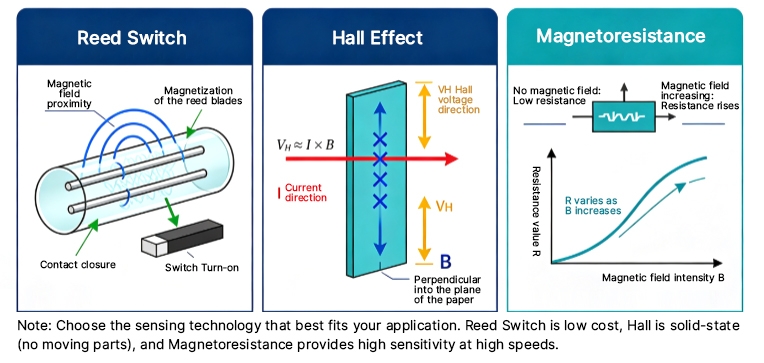
A magnetic sensor is a device that detects magnetic fields. It can measure the strength, direction, or presence of a magnet. One common type is the Hall effect sensor, which produces a voltage when exposed to a magnetic field. Another type is the magnetoresistive sensor, which changes its resistance.
Working Principles
|
Technology Type |
Principle |
Typical Products |
Features |
|
Reed Switch |
Mechanical contact: two magnetic reed pieces pull together when a magnet is near |
2-wire economy type, wide-voltage type |
No power needed; handles high voltage; low cost; slow switching speed; has a limited mechanical life |
|
Hall Effect |
Semiconductor magnetic sensor |
3-wire PNP/NPN, safety switch (non-coded) |
Electronic switching; fast response; no contact wear; needs a power supply |
|
Magnetoresistive + Encoding (MR + RFID) |
Magnetoresistive effect plus coded identification |
Safety switch (coded) |
Tamper-proof; resists interference; meets safety standards |
Our choice: Hall & reed over coils. Coils are great for measuring how fast something spins. But our sensors answer a different question: "Is it there yet?" – detecting a magnet at a specific position. Hall and reed sensors nail that job with reliable, contactless switching, while coils can't even see a stationary magnet. Different tools for different jobs.
FAQ
Q1: Should I choose a 2‑wire or a 3‑wire sensor? What’s the difference?
A: This is the first big decision you need to make.
|
2‑wire |
3‑wire |
|
The two wires carry both power and signal – the sensor is connected in series with the load. |
One wire for power (brown), one for ground (blue), and a separate output wire (black) for the signal. |
|
Works with reed switches (mechanical contacts) or solid‑state electronic types. |
Works with PNP/NPN electronic outputs (like Hall sensors). |
|
Saves cable; easy to upgrade old machines; works with both AC and DC (wide‑voltage types). |
More stable signal; standard for PLC systems; supports more complex logic. |
|
Typical products: wide‑voltage reed sensors, 2‑wire cylinder sensors. |
Typical products: 3‑wire PNP/NPN cylinder sensors, proximity‑style sensors. |
Quick pick: For retrofitting old equipment or tight spaces → choose 2‑wire. For new projects or PLC systems → choose 3‑wire.
Q2: How do I choose between NPN and PNP? And what about NO (normally open) vs. NC (normally closed)?
A: This is the most common confusion with 3‑wire sensors.
- NPN (sinking): output goes low (0V). The output connects to the negative side of the load. Best for Japanese PLCs (like Mitsubishi, Omron).
- PNP (sourcing): output goes high (supply voltage). The output connects to the positive side of the load. Best for European PLCs (like Siemens, Beckhoff).
- NO (normally open): the output is off (open) when there is no magnetic field, and closes (turns on) when the field is present. Used for position detection, counting, etc.
- NC (normally closed): the output is on (closed) when there is no field, and opens (turns off) when the field is present. Used in safety circuits – if a wire breaks, the alarm goes off.
Most products offer both NO and NC versions, or the NC function can be changed by external wiring.
Q3: What do the switching frequencies (100 Hz, 200 Hz, 1000 Hz, 1500 Hz) actually mean?
A: The frequency tells you how fast the sensor can respond to changing magnetic fields. Pick based on how fast your target moves.
|
Frequency |
Best for |
Speed reference |
|
≤ 200 Hz (reed switch) |
Door switches, general cylinder position, counting objects on a conveyor (speed up to ~1 m/s) |
Good for most everyday jobs |
|
1000 Hz (standard Hall) |
High‑speed cylinders, rotary encoder counting (~5 m/s) |
Faster automation |
|
1500 Hz (small Hall, M8/M12) |
High‑speed rotating detection, small mounting spaces (~8 m/s) |
Very fast applications |
For example: A conveyor moving 5,000 parts per hour equals about 1.4 Hz – so 200 Hz is more than enough for most cases. You only need 1000 Hz+ for really high‑speed automation.
Q4: Why are there both wide‑voltage (5‑240V AC/DC) and low‑voltage (10‑30V DC) power supplies?
A: This difference comes down to the technology inside.
- Wide voltage (5‑240V AC/DC): only reed switches can do this, because they are just mechanical contacts – they don’t need electricity to work. You can connect them to 24V DC, 110V AC, or even 220V AC. Great for upgrading old machines or places with mixed power supplies.
- Low voltage (10‑30V DC): electronic sensors like Hall types need a stable DC supply to run their internal circuits. Most new projects and modern PLC systems use 24V DC, so this is the standard choice.
Bottom line: If your controller is 24V DC, both types work. If your controller uses 110V or 220V AC, you must choose the wide‑voltage reed switch.


