
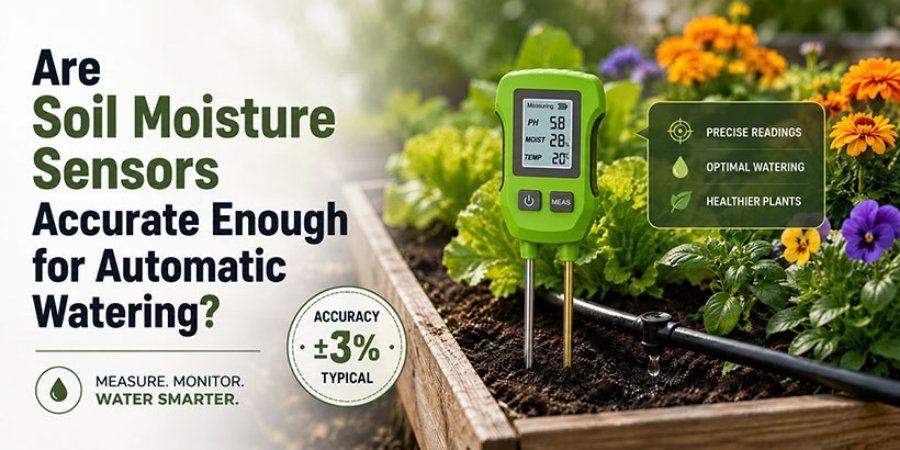
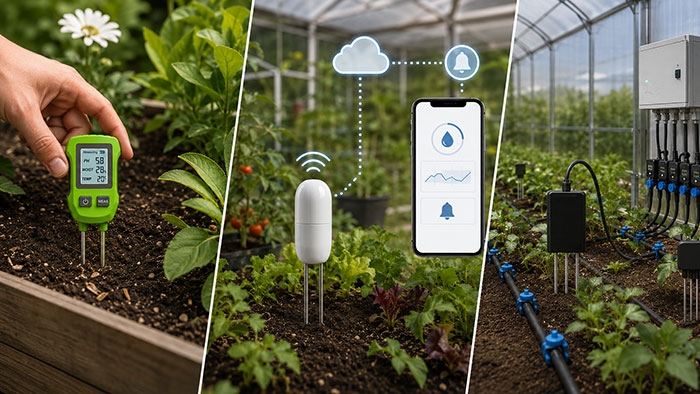
Whether a soil moisture sensor is suitable for automated watering depends on whether it is a digital, wireless, analog output, or RS485/Modbus sensor. Simple digital sensors are suitable for routine checks, wireless soil moisture sensors are suitable for remote monitoring, and RS485/Modbus and 4–20 mA output soil moisture sensors are better suited for agriculture, greenhouses, and automated irrigation control systems.
Why Does the Type of Sensor Affect Automated Watering?
Automated watering systems require not only information on whether the soil is dry or wet, but also stable, repeatable, and controllable data input. Different types of soil moisture sensors vary significantly in terms of accuracy, communication methods, installation methods, and system compatibility.
If the soil moisture sensor is used solely for gardening, a simple digital display or wireless app monitoring is sufficient. However, for greenhouse irrigation, agricultural irrigation, or PLC control systems, industrial-grade soil moisture sensors with RS485, 4–20 mA, 0–10 V, or relay outputs are more suitable.
Soil moisture sensors are useful tools for determining when plants truly need water, but choosing the right sensor depends on soil type, installation depth, output signal, and irrigation control requirements. For more information on soil moisture sensor types, applications, and monitoring solutions, please visit SUCH Sensor.
Comparison of Common Soil Moisture Sensor Types
| Type | Suitable Applications | Automatic Watering Suitability |
| Digital Soil Moisture Sensor | Plant pots, gardens, manual monitoring | Moderate |
| WIFI Soil Moisture Sensor with Temperature | Home gardening, remote monitoring | Moderate to high |
| FDR Soil Moisture Sensor | Controllers, solenoid valves, pump systems | High |
| Tensiometer Soil Moisture Sensor, RS485/Modbus | Greenhouses, farms, industrial irrigation | Very high |
| Multi Depth Soil Moisture Sensor for Agriculture | Farmland, orchards, greenhouses | Very high |
Are Simple Digital Sensors Suitable for Automatic Watering?
Simple digital soil moisture sensors typically feature a display that allows you to directly view soil moisture, temperature, or other parameters. Their advantages include being intuitive, cost-effective, and easy to install.
However, if used for automatic watering, two issues should be noted:
First, digital display sensors are generally better suited for manual assessment and may not provide a stable control output. Second, they may lack remote communication, data logging, or automatic control interfaces.
Therefore, simple digital sensors are better suited as monitoring tools rather than as the core control signals for complex automated irrigation systems.
What Scenarios are Wireless Soil Moisture Sensors Suitable for?
Wireless soil moisture sensors are ideal for users who need to view data remotely. Examples include home gardens, greenhouses, balcony gardening, rooftop gardens, or small farms. Users can monitor changes in soil moisture via an app, gateway, or cloud platform, and can also set up alert notifications.
The advantage of wireless soil moisture sensors is their flexible installation, which eliminates the need for long-distance wiring. However, if used to directly control automatic watering, you must verify whether the system supports linked control, whether battery life is stable, and whether the wireless signal covers the entire area.
For users setting up automatic watering for the first time, it is recommended to use wireless sensors for observation for a period of time before deciding whether to connect them to an automated control system.
Why are RS485/Modbus Sensors Better Suited for Greenhouse Irrigation?
RS485/Modbus soil moisture sensors are better suited for professional automated irrigation systems. They can connect to PLCs, data loggers, industrial PCs, or smart irrigation controllers, making them ideal for multi-point deployment and long-term monitoring. In greenhouse environments, crop density is high, irrigation frequency is frequent, and environmental conditions change rapidly. Using soil moisture sensors with RS485 output allows for simultaneous data collection from multiple locations, facilitating zone-based control.
For example:
- Zone 1 soil moisture is low → Turn on irrigation for Zone 1 only
- Zone 2 soil moisture is normal → Keep it off
- Zone 3 soil moisture is too high → Delay watering
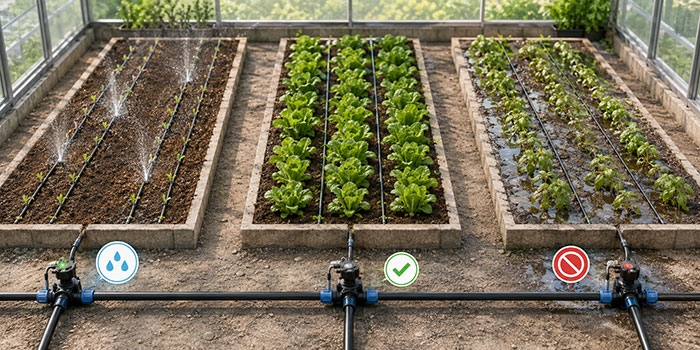
This control method is more reliable than using single-point sensors.
Which Output Signals Should Be Prioritized for Automatic Watering?
| Output Signals | Suitable Applications |
| 4-20 mA | Industrial control, with good interference resistance |
| 0-10 V | Common Controller Inputs |
| RS-485 Modbus | Multi-point monitoring, long-distance communication |
| Relay outputs | Simple on/off control |
| Wireless signals | App monitoring, remote alarms |
For professional greenhouses or farms, prioritize RS485/Modbus or 4–20 mA. For home use, digital displays or wireless models are easier to get started with.
How Can You Determine If a Sensor is Stable Enough?
You can assess stability based on the following factors:
- Are the readings consistently stable?
- Are there significant variations when the sensor is repeatedly inserted into the same soil?
- Do the readings increase reasonably after watering?
- Do the readings decrease steadily as the soil gradually dries out?
- Has the sensor been calibrated for use in different soil types?
- Is it affected by corrosion or salt buildup during long-term use?
Stability is more important than one-time accuracy. Automated watering requires repeatable, interpretable trend data.
FAQ
- Q1: Can wireless soil moisture sensors control automatic watering?
- A1: Yes, but you need to confirm whether they support integration with valves, water pumps, or controllers.
- Q2: Are RS485 soil moisture sensors suitable for home gardens?
- A2: They can be used, but installation may be complex for the average home user; they are better suited for greenhouses and farms.
- Q3: Which is better for automatic irrigation: 4–20 mA or RS485?
- A3: 4–20 mA is an option for single-point control, while RS485 is better suited for multi-point monitoring and long-distance communication.
- Q4: What is the most important factor in an automatic watering system?
- A4: It’s not a single sensor reading, but rather stable data, reasonable thresholds, delay control, and proper installation.
Soil moisture sensors work for automated irrigation, but only if they are not treated as simple on/off switches. The correct approach is to calibrate the sensor according to soil type, install it in the root zone, set reasonable thresholds, and incorporate delay or multiple-confirmation logic.
Simple digital models are suitable for manual monitoring, wireless models are suitable for remote monitoring, and RS485/Modbus and analog output models are better suited for true automated irrigation control. If the application is for greenhouses, farms, or automated control systems, we recommend selecting soil moisture sensors that support stable output, are calibratable, and allow for multi-point deployment.


