

If you've ever needed to know whether a piece of equipment is level, leaning, or shifting out of position, you've run into the exact problem a tilt sensor is designed to solve. This guide covers what tilt sensors are, how they work, the different types available, and what to look for when choosing one.
What Is a Tilt Sensor?
A tilt sensor (also called an inclinometer) measures the angle of an object relative to gravity. Instead of tracking speed or rotation like a gyroscope, a tilt sensor tells you how much something is leaning—whether that's a piece of machinery, a vehicle chassis, a solar panel, or a structural support beam.
This makes tilt sensors valuable anywhere orientation and stability matter: construction equipment, agricultural machinery, robotics, platform leveling systems, and structural or geotechnical monitoring are all common use cases.
How Does a Tilt Sensor Work?
Most modern tilt sensors use MEMS (Micro-Electro-Mechanical Systems) accelerometer technology. Inside the sensor, a tiny mechanical structure responds to gravitational pull. As the sensor's orientation changes, the internal structure shifts slightly, and this shift is converted into an electrical signal that corresponds to a specific tilt angle.
That signal is then processed and delivered through an output format—commonly RS485, RS232, CAN bus, analog voltage/current, Bluetooth, or a simple relay/switch signal—so it can be read by a controller, PLC, monitoring system, or mobile device.
Some tilt sensors measure tilt along a single axis (X), while others measure across two or even three axes (X, Y, Z—sometimes described as pitch, roll, and azimuth) for more complete orientation data. The right choice depends on whether your application needs simple level detection or full multi-directional positioning.
Common Types of Tilt Sensors
Tilt sensors aren't one-size-fits-all—different designs suit different jobs. Broadly, they tend to fall into a few categories:
- Basic switch/alarm-type sensors: trigger a relay or alarm output once a set tilt angle is exceeded, often used for simple threshold monitoring rather than continuous measurement.
- Standard analog or digital inclinometers: provide continuous tilt readings via analog signals (0-5V, 4-20mA) or digital protocols (RS485, Modbus, CAN).
- High-precision inclinometers: built for applications needing fine resolution and tight accuracy, often supporting multiple communication protocols.
- Multi-axis / dynamic sensors: measure pitch, roll, and sometimes azimuth simultaneously, useful for vehicles or platforms that move in more than one plane.
- Ruggedized variants: including waterproof and explosion-proof housings for harsh or hazardous environments.
- Wireless sensors: transmit data via Bluetooth or through a separate wireless transmission module, useful where running cables isn't practical.
- Standalone display monitors: combine a tilt sensor with a built-in screen, allowing on-site angle readings without connecting to external equipment.
How to Choose the Right Tilt Sensor?
A few quick factors to check:
- Measuring range: match the sensor's angle range to your actual application, from narrow (±3°) to wide (±180°)
- Axis configuration: single-axis for simple tilt, dual/3-axis for multi-directional movement
- Output signal: RS485/Modbus, CAN, analog, relay, or Bluetooth, depending on what your system needs to talk to
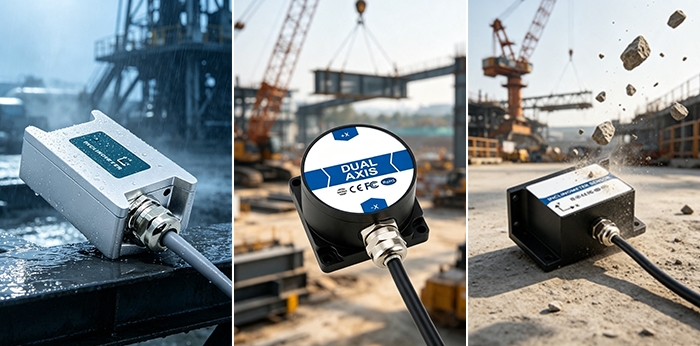
- Environmental conditions: IP67 for wet/dusty environments, explosion-proof for hazardous areas
- Precision: higher accuracy generally costs more, so match it to what the application actually requires
Which Tilt Sensor Fits Your Application?
| Application | Recommended Type | Why It Fits |
| Heavy machinery & vehicle leveling (cranes, excavators) | CAN bus inclinometer (CANopen/CAN 2.0) | Native compatibility with vehicle control systems |
| Vehicles, platforms, or drones moving across multiple planes | 3-axis dynamic sensor (pitch/roll/azimuth) | Captures full multi-directional orientation |
| Outdoor, marine, or agricultural use | Waterproof inclinometer | IP67-rated with rugged metal housing |
| Hazardous or combustible environments (oil & gas, mining) | Explosion-proof tilt sensor | Built to meet safety requirements in volatile atmospheres |
| Hard-to-wire locations or mobile monitoring | Bluetooth tilt sensor / wireless module | Eliminates cabling constraints |
| On-site angle readout without a separate control system | Display-equipped tilt monitor | Standalone, human-readable output |
| Basic control systems without digital communication | Analog output inclinometer (0-5V / 4-20mA) | Simple wiring, broad compatibility |
A few practical takeaways from this table:
- Vehicle and heavy equipment applications tend to favor CAN-based sensors, since that's the native communication standard in many vehicle systems.
- If your equipment moves in more than one plane (like a drone, vessel, or mobile platform), a 3-axis dynamic sensor gives a more complete picture than single-axis models.
- Environment matters as much as specs—waterproof and explosion-proof variants exist specifically because standard housings aren't suited to every job site.
- If cabling isn't practical, a Bluetooth or wireless module removes that constraint entirely, while a display-equipped monitor works well when you just need an on-site reading.
Final Thoughts
Choosing the right tilt sensor comes down to matching a few key factors—measuring range, axis configuration, output signal, environmental conditions, and precision—to your specific application. There's rarely a single "best" option; the right choice depends on what your system needs to communicate with, where it will operate, and how precise your tilt measurements need to be.
If you're not sure which configuration fits your setup, feel free to reach out—we're happy to help you find the right match from our tilt sensor lineup. Explore our full range of tilt sensors at such.com.


